
For all orders over £15
Free Shipping

What role does construction play in global environmental impact and the carbon footprint?
The construction industry is responsible for a significant share of global greenhouse gas emissions and other environmental impacts. Sustainable construction aims to reduce these impacts across the whole building lifecycle, from raw material extraction through use, demolition and disposal. This shift has driven the use of tools such as Environmental Product Declarations (EPDs), and the number of published EPDs has surged in the last two years as demand for product‑ and project‑specific data grows.
What is an Environmental Product Declaration (EPD)?
An Environmental Product Declaration (EPD) is a transparent, standardised document that reports the quantified environmental impacts of a product across its lifecycle. It covers factors such as raw material extraction, manufacturing processes, energy use, emissions and waste generation. EPDs provide comparable information that helps stakeholders choose products that align with sustainability goals.
What is EPD verification?
EPD verification is a rigorous, independent review process that confirms the accuracy and completeness of an EPD. Third‑party organisations check that the underlying assessment follows internationally recognised standards, most notably ISO 14025 and EN 15804. Verified EPDs give specifiers confidence that the reported impacts are reliable, comparable and based on consistent rules.
Who uses EPD’s and why are they important?
EPD’s are used by architects, engineers, contractors, developers and other decision‑makers to select building materials with lower environmental impact. They support the achievement of green building certifications such as LEED, WELL and BREEAM, where points are often awarded for using products with EPD’s. As environmental regulations tighten, EPD’s increasingly serve as evidence of compliance with mandatory sustainability criteria, and they are expected to become fundamental in public sector low‑carbon procurement.
How does EN 15804 define lifecycle stages in an EPD?
Under EN 15804, the lifecycle of construction products is divided into four main stages:
These stages allow clear comparison of products on a like‑for‑like basis.
Why does EPD verification matter for paints?
For paints, a verified EPD confirms that the manufacturer has robustly assessed and disclosed the environmental impacts of the product. This includes indicators such as carbon footprint (Global Warming Potential), VOC emissions, CO2 absorption (for some lime‑based products) and other relevant metrics. Verified EPDs add credibility and accountability to environmental claims and help project teams justify product selection in sustainability strategies.
How do I compare the environmental impact of different paints?
Most paint comparisons focus on Global Warming Potential (GWP) in the production and transport stages (A1–A3), but other stages can also be important. Transport to site (A4) is influenced by paint volume solids and coverage, and the application stage (A5) is critical because harmful VOCs can be emitted during drying and curing. Some lime paints, such as Ambient Pro+, can even absorb CO2 during curing, significantly reducing their cradle‑to‑gate GWP.
What is Global Warming Potential (GWP) and how is it expressed?
Global Warming Potential is a measure of the climate impact of greenhouse gas emissions, expressed as kilograms of CO2 equivalent (kg CO2e). For paints in building projects, GWP is often reported per square metre of coated surface per coat, for example kg CO2e/m² per coat. This unit makes it easy to compare products and scale the results to the actual surface area being painted.
How can I calculate CO2e savings between two paints?
To compare paints using their EPD data, you can follow this method:
This simple calculation uses EPD figures to show the carbon benefit of choosing a lower‑impact paint on a project.
How does Ambient Pro+ compare with a typical Airpure matt paint?
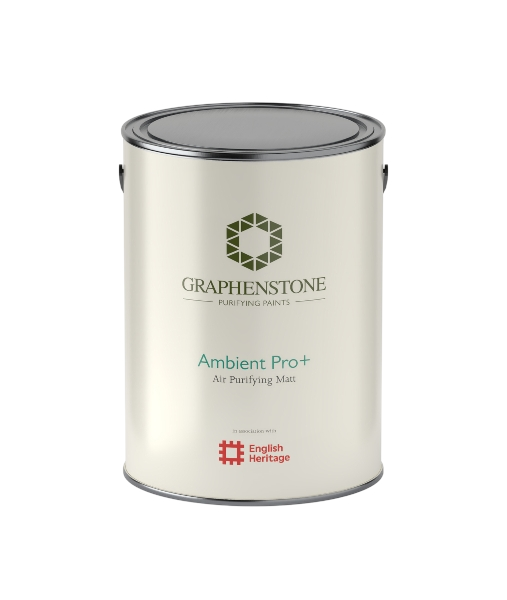
Ambient Pro+ is a lime‑based paint with a verified EPD and a Global Warming Potential of 0.089 kg CO2e/m² per coat (A1–A3). A commercially available Airpure matt paint from a leading supplier has a GWP of 0.492 kg CO2e/m² per coat.
For a hotel and spa project with 15,000 m² of interior walls and ceilings requiring two coats:
Ambient Pro+ reduces the A1–A3 carbon footprint from 14,760 kg CO2e to 2,670 kg CO2e on this Hotel Spa project.
In addition because Ambient Pro+ is a pure lime paint, it absorbs CO2 during the curing process, mainly in the first 30 days, at a rate of about 0.36 kg per litre. On the 15,000 m² project above, approximately 1,667 litres of paint are required, leading to about 600 kg of CO2 absorbed during application (A5).
When this absorption is taken into account, the overall carbon footprint for stages A1–A5 for Ambient Pro+ falls from 2,670 kg CO2e to around 2,070 kg CO2e, increasing the total saving to 12,690 kg CO2e on the Hotel Spa project.
How do EPD‑verified paints compare to non‑verified paints?
Many low‑cost trade paints and some clay paints used in commercial buildings have no EPD verification. Without verified data, their actual carbon footprint and VOC profile are often higher and harder to substantiate. The CO2e savings from switching to Graphenstone EPD‑verified products are therefore likely to be significantly greater than in the example above, and many non‑verified paints are expected to be phased out as regulations and market expectations tighten.
What is the overall benefit of using EPD‑backed products in buildings?
Environmental Product Declarations are central to sustainable construction because they provide comprehensive, transparent data on the environmental impacts of materials. Specifying products with strong environmental credentials reduces the embodied carbon of the building, supports higher retained asset value and contributes to healthier indoor environments. Over time, this benefits both the environment and the wellbeing of the people who live and work in these buildings.
Click on the links throughout the text for more information regarding specific products. Alternatively, contact us using the information below… Email:- sales@avace.co.uk | Phone:- 01384 400355 | Business WhatsApp:- +441384 400355